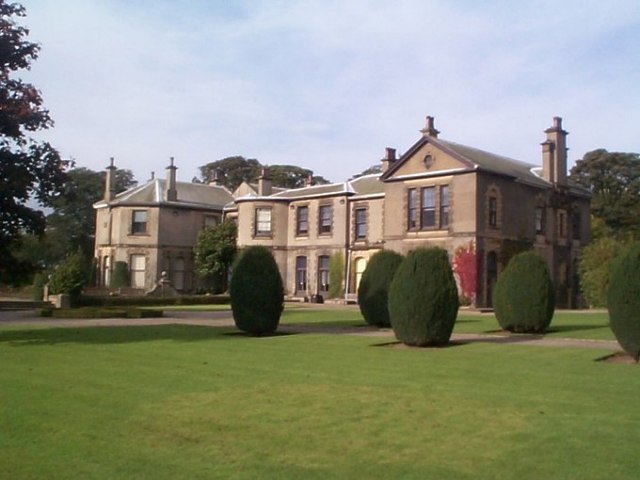
Lotherton Hall is a country house near Aberford, West Yorkshire, England. It lies a short distance from the A1(M) motorway, 200 miles (320 km) equidistant between London and Edinburgh. It is one of nine sites in the Leeds Museums & Galleries group.
The Hall is sited on part of the Gascoigne estate, and was presented to the City of Leeds in 1968 by Sir Alvary Gascoigne and his wife, last of the Gascoigne family, whose roots were at Parlington Hall. The Hall and parkland were opened for public access by its new owners on 6 August 1969, exactly 25 years after Sir Alvary Gascoigne's only son and heir, Douglas Gascoigne, was killed in a tank battle in Normandy. The estate is home to an extensive collection of endangered bird species and a herd of red deer. There is a large expanse of grassland in front of the bird garden, typically used during the summer months for ball games and picnics. A further field is often used to host shows, such as an annual motorcycle show.
The Hall, which was extensively rebuilt during the Victorian and Edwardian eras, holds an impressive art collection. This includes the Gascoigne Gift, given to the City of Leeds along with the Hall, which sits alongside Designated collections of fine art and decorative arts added to Hall since becoming a museum in 1968. The Hall is licensed to hold wedding and civil partnership ceremonies.
*** – History – ***
There has been a manor house on the site of the current Hall from at least 1775, where it appears on Thomas Jeffery's map of Yorkshire. The house at this time was owned by Thomas Maude, who had brought it from George Rhodes in 1753 for £4,115. Ownership then passed to Wollen and then to John Raper. In 1824 John Raper died and his son and heir, John Lamplugh Raper, sold the property to Richard Oliver Gascoigne in 1825.
Lotherton Hall first came into the possession of the Gascoigne family when it was purchased in 1825 by Richard Oliver Gascoigne. He would have presumed he had secured a male heir, as he had raised two adult sons, Richard Silver Oliver and Thomas Gascoigne; the latter he expected to inherit. However in 1842 both of Richard Oliver Gascoigne's sons passed away leaving the Gascoigne estate to be inherited by his daughters, Mary Isabella Gascoigne (1810-1891) and Elizabeth Gascoigne (1812-1893).
They inherited the following year in 1843, when Richard Oliver Gascoigne died. The sisters divided the Yorkshire estates between them, Mary Isabella took Parlington Hall, whilst Elizabeth took Lotherton Hall. During Elizabeth Gascoigne's ownership, she and her husband Fredrick Mason Trench, the 2nd Baron of Ashtown, who she married in 1852 becoming Lady Ashtown, mostly let Lotherton to tenants, preferring Castle Oliver in Ireland, along with Woodlawn, Lord Ashtown's own family residence in County Galway, Ireland.
Lord and Lady Ashtown did however seem to use Lotherton as their Yorkshire seat for a time in the 1850s. On Elizabeth's death in 1893, Lotherton was inherited by her nephew, Colonel Fredrick Richard Thomas Trench Gascoigne who was a noted soldier and traveller.
Colonel Gascoigne's wife Gwendolen Gascoigne, who was the daughter of noted engineer Sir Douglas Galton, was also the second cousin and god daughter to Florence Nightingale. Colonel Gascoigne preferred Lotherton Hall over his family home of Parlington, moving a lot of the furnishing in to Lotherton. This left Parlington abandoned and was later demolished in the 1950s.
A lot of the alterations and remodelling that Colonel Gascoigne and Mrs Gascoigne made to Lotherton to accommodate their growing family, are still visible today. Between 1896 to 1931 extensive remodelling was done to the house, a new dining room, entrance hall, drawing room and servants wing were added. In addition to this Mrs Gascoigne designed and built Edwardian style gardens along the south front. Colonel and Mrs Gascoigne had three children together, Alvary, Oliver (who died as an infant) and Cynthia.
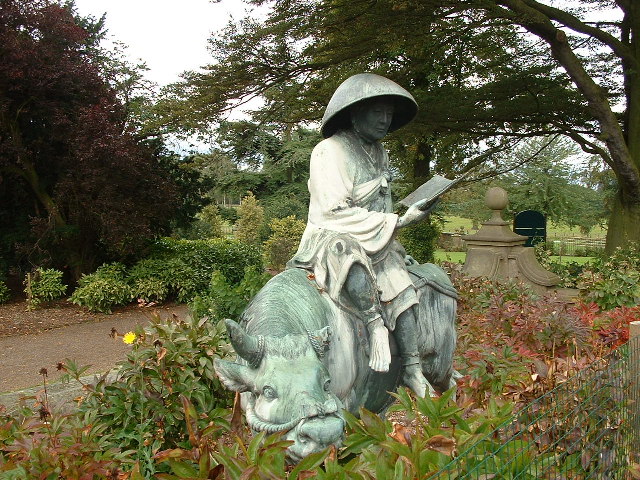
Sir Alvary Gascoigne was a British ambassador to Japan and Moscow, he inherited Lotherton on 1937 and lived there with his second wife, Lorna Priscilla Gascoigne. Whilst at Lotherton he made several alterations to the house, mostly enriching the house with oriental works he had acquired whilst an ambassador. He and his first wife, Sylvia Wilder, had a son together, Douglas Wilder Gascoigne, who was killed in action during the Second World War. With no heir left to inherit Lotherton Sir Alvary presented Lotherton Hall to the City of Leeds in 1968 as a gift to be open to the public. He also gave an endowment fund to buy works of art to further the collection. He died in 1970.
The Gascoignes were a very patriotic family and felt as though it was their duty to help the war effort during WW1. In November of 1914, Lotherton hall had been transformed into a Voluntary Aid Detachment (V.A.D) hospital for wounded soldiers. The hospital was mainly ran by Mrs Gascoigne (Laura Gwendolyn Gascoigne née Galton), with the help of VAD volunteer nurses and her daughter Cynthia Gascoigne.
Initially the hospital started off with only eighteen beds at the start of the war but would increase to thirty five by the end of the war. Between the 21st of November 1914 to the 28th of March 1919, 655 soldiers were treated at the hospital. The Gascoignes funded the hospital using their own money and refused government grants or aid. Colonel Gascoigne volunteered as an ambulance driver on the western front, with their son Alvary serving in the army. Their effort in the war was much appreciated by the local community and the St Johns Ambulance Service so that in 1918 Mrs Gascoigne was awarded a CBE.
*** – Hall and Chapel – ***
As well as displaying the beautiful items given by the Gascoignes, Lotherton is a treasure-trove of internationally important 19th and 20th century decorative art, including objects from many important designers and makers. Changing displays include fine furniture, ceramics, silver, metalwork, jewellery and more.
*** – Grounds and Gardens – ***
The beautiful Edwardian gardens cover an impressive eight acres and include a walled garden with rose beds and herbaceous borders featuring scented flowers, creepers and perennials.
Part of the Victorian shrubbery was made into a rock garden, with winding sunken paths and a hard tennis court was laid out overlooking the pasture. Today, the gardens are being slowly restored.
*** – Wildlife World – ***
Lotherton’s zoo, Wildlife World, tells the story of the world’s natural heritage. It is a continued development of the original Bird Garden which has been a part of the estate since the 1980s.
Here you can meet playful Humboldt penguins as they splash about in their pool, see flamingos in their habitat and say hello to the resident tapir and capybaras. They invite you to get to know the animals, how they live and what we can do to protect their future. Wildlife World is located within the grounds of Lotherton. Their opening hours are 10am-5pm from April to the end of October and 10am-4pm until March in line with daylight savings time.
Wildlife World contributes to conservation initiatives by taking part in European breeding programmes and aims to raise awareness of endangered animals and plant species through an exciting learning and events programme.
*** – Visiting – ***
They kindly ask that prams, pushchairs, rucksack style baby carriers and bags larger than an A4 piece of paper are not brought into the hall.
Guided tours are available daily, January to February at 11am and 2pm. The hall is open in February half term and upstairs is open on a seasonal basis from March to October. Click here for a comprehensive calendar of What's On at Lothertton Hall.
*** – Facilities – ***
*** – Access – ***
They aim to provide a friendly, accessible environment for all their visitors and the widest possible access to their buildings, exhibitions and collections. Situated just outside Aberford, the museum is approximately 12 miles from Leeds. It is 4 miles from the nearest train station at Garforth. Lotherton is a 20-25 minute walk from the nearest bus stop in Aberford, along a public highway with limited footpaths. A 180 meter long drive leads up to the entry kiosk.
Carers. Entrance to Lotherton is free for carers.
Entrances. The House has ramped access. The entrance is manual, opening inwards with a clear opening space. There is a bell on the information panel if you require help to open the doors. The Shop and Stables Café entrances are both level. The doors are both manual, opening inwards with clear opening spaces.
Accessible toilets. There is a Changing Places and accessible toilet in the Stables Courtyard, and there is an accessible toilet in the house and café. Baby changing facilities are available in the café, courtyard toilets and inside the house. There is also a baby feeding room in the house.
Disabled parking. There are several accessible parking spaces in the car park nearest to the House and Bird Garden. This car park is used as priority parking during the busier summer months. Access from the car park to the house and Wildlife World entrances is via fairly gradual uphill pathways.
Guide and assistance dogs. Guide and assistance dogs are welcome to all areas except the house, Stables Café and bird garden, although guide and assistance dogs are welcome in the house. Dogs need to be kept on leads in the gardens and courtyard but are free to roam around the rest of the grounds if kept under control. Water and bowls are available in the courtyard.
The House. A proportion of the house is fully accessible. There is a lift in the house and almost all visitor areas, including the Fashion Galleries, are now fully accessible. Due to the historic nature of the house and its displays, larger motorised wheelchairs and scooters cannot navigate the visitor route, so these aids are not permitted. Light wheelchairs are available to borrow for use in the house.
Some rooms on the first floor are accessed by a chair lift. The School Room, used by pre-booked groups, is inaccessible to wheelchair users but alternatives are offered. Please discuss any access needs with the Learning and Access Officer when booking your visit. There is seating around the house including folding seats, which are available for visitors to use. Some areas within the House are touch and handling friendly, particularly the Servants Rooms on the ground floor.
Grounds and Wildlife World. The majority of the grounds, gardens and Wildlife World are fully accessible with total visibility from various viewpoints. Due to its historic design, the Edwardian Garden is not fully accessible to wheelchair users, but can be viewed from vantage points. Manual and push wheelchairs may struggle on some of the gravel areas.
Wildlife World is fully accessible but some pathways are fairly steep and gravelled in parts. The courtyard and Stables Café are fully accessible. Electric wheelchairs must be left outside of the café, shop and stables.
One manual wheelchair is are available from reception to use within the house. Unfortunately they cannot provide assistance to get around the house for wheelchair users. Another manual wheelchair is available from the Stables Café which can be used in the grounds. Three mobility scooters are available from the welcome cabin to use on the estate which can be booked in advance. Please email them in advance of your visit if you would like to discuss specific access needs.
Hearing impaired and deaf visitors. There are no induction loops at Lotherton.
Lotherton estate is a member of the Visitor Attraction Quality Assurance Scheme (VAQAS). The VAQAS is a scheme which ensures high quality experiences at tourist attractions, including a commitment to respect the requirements of the Equality Act 2010 by making reasonable adjustments to improve service for disabled people.

Location : Lotherton Hall, Lotherton Lane, Aberford, Leeds LS25 3EB
Transport: Garforth (National Rail) then taxi, 4 miles. Bus Routes : 64 and 64 stop in Aberford then 20- 30 minutes walk.
Opening Times: Daily, Nov. to Feb. 10:00 to 16:00; March to Oct. 10:00 to 17:00
Tickets Park: Free.
Tickets Wildlife World + Hall: Adults £7.80; Children (5 - 15) £3.90. Carers Free.
Tel: 0113 378 2959

