
The Agricultural museum in Brook is an excellent museum to study rural life in Kent, the Garden of England. The Domesday Book records that the area around Brook was farmed by monks from Christchurch Canterbury. In the 1370s the farm reverted to private occupancy and this is when the barn was built. It is therefore a manorial barn. East Kent is particularly rich in timber barns as the area has long been used primarily for farming. A typical method of construction for the larger barns was to have a central aisle with bays either side. Brook barn has six full bays either side with two passage bays. The barn is built with English oak, almost all of which is original and in excellent condition. It has a crown post roof, as can be seen in the picture below. Other construction details of particular interest and occurring only in early medieval barns are the use of scarf joints to connect the main plates and jowls at the head of the main posts. The barn is well worth a visit in its own right. The barn may have had a Kent peg tile roof when it was constructed as the brick works at nearby Naccolt produced some of the finest roof tiles from an early date. In the 1970’s the roof was re-tiled and most of the original tiles were used. It was recommended at the time that roofing felt be put under the tiles to keep the elements and birds out. In the 1950’s windows were installed on the rear side of the barn to improve lighting.
The principal purpose of the barn was to store the harvest for processing in the winter. The passage bays extend outside the main aisled construction at the rear of the barn. The wagons carrying the corn entered through these large doors and after unloading, the wagon left through the smaller doors on the opposite side. The inferior construction of the large door entry bays suggests that they were constructed at a later date than the rest of the barn, when larger wagons came into use. One of the passage bays has a hardwood floor. In the winter the sheaves of corn were laid on this floor and beaten with a flail, the latter consisting of two pieces of wood about a metre long with a universal joint between, generally made from leather. One piece of wood was the handle and the other, after being swung over the head, was used for striking the sheaf. This was called threshing and broke up the ear of corn into the grain and chaff. On a breezy day with the boards removed from one barn door and the opposite barn door open, the chaff and grain were thrown in the air to separate them. This was called winnowing. Between the front of the barn and the road there is a horse gear. This consists of a large gear wheel at ground level to which a shaft is attached. The shaft was coupled with chains to a horse which walked round driving the gear wheel. The latter was attached to a drive shaft which went into the barn to drive various types of machinery. At the beginning of the 19th century threshing machines began to appear and these took away the winter threshing work from the poorly paid farm workers.
The growing of hops in Kent used to be a major industry with the result that a large number of oast houses were constructed to dry the hops. Up to the beginning of the 19th century oast houses were generally square but early in the 1800’s the circular oast was introduced. It was thought that with a circular kiln the hops would be dried more evenly than with a square construction. This was later shown not to be true, but the consequence was that Kent inherited a wealth of circular oasts with their attractive tiled roofs, white cowls and wind vanes. Most of these oasts have been converted for residential use but the Brook oast, which was built in 1815, remains largely intact. When the hops were picked they had a moisture content of about 80%, which had to be reduced to around 6% so they could be stored. The circular part of the oast is simply a chimney for the furnaces at the base. The Brook oast is a rare example of one with an inner circle. The inner circle consisted of brick vaulting, which was keyed in to the outer brickwork of the kiln. Four furnaces were constructed at the base, equally spaced around the inner circle, some of which has been removed to enable visitors to view the full construction.
The wet hops were placed on the drying floor above the furnaces. The pokes, which contained the wet hops, were almost certainly brought into the oast by a hoist in the roof. It is thought that the roof was re-tiled in the early part of the 20th century, with the dormer containing the hoist being removed. The wet hops were then moved from the upper floor and placed on a horsehair mat on laths, which made up the drying floor. The hops were laid to a depth of about 300mm and then dried for 8 to 10 hours. Charcoal was originally burnt to dry the hops but in the early 20th century hard coal, such as anthracite was introduced. A pan containing sulphur was placed on one of the furnaces whilst the hops were being dried and the resultant sulphur dioxide (plus combustion gases) passed through the hops giving them the distinctive bloom required by the hop merchant. After the hops had been dried they were brought out on to the cooling floor. The hops were still hot when they were taken from the kiln and it was necessary to cool them and stabilise the moisture content before they were pressed into sacks. The sacks used for storing the hops, called pockets, were hung under the hop press at the far end of the cooling floor. The cooled hops were placed in the pockets and then compressed some 14 times until the hop pocket was full and rigid.
In the barn are the ploughs. A plough is pulled across the field and cuts a rectangular furrow slice with two knives, the share and the coulter. The furrow slice is then flipped over by the wrest or mouldboard to make a furrow. With a fixed wrest the furrow always fell in one direction. If you went up the field and then back again the furrows rested like a row of dominoes. In Kent, mainly due to the heavy soil and rolling landscape, a turnwrest plough was used. In simple terms, the wrest could be taken off and put on the other side of the plough when coming back across the field. With this method of ploughing all the furrow slices rested on top of each other. When ploughing on the side of a hill all the furrow slices could point uphill thereby helping to prevent erosion. A development of the turnwrest plough was the balance, one way or cock up plough. This had two shares, coulters and mouldboards arranged so that only one was used at a time, the other being up in the air. After one furrow had been cut the tow bar is swung over to bring the part which had been up in the air down to the ground and the second furrow was then cut. The second mouldboard threw the new furrow in the same direction as the first, so that each furrow rested on top of the previous one.
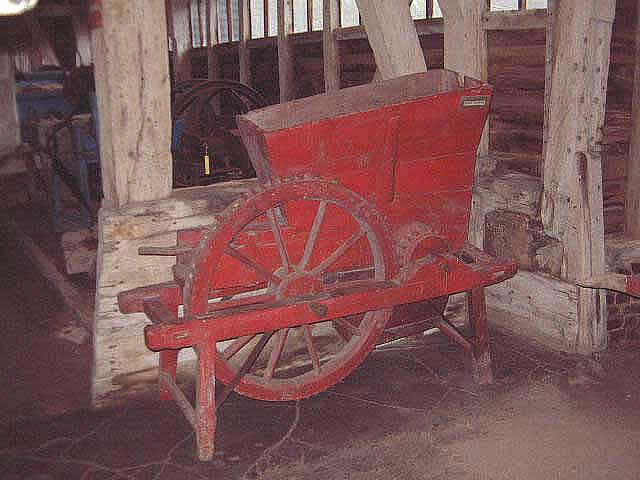
There are many different pieces of equipment in the museum for sowing seed but perhaps the simplest is the seed lip. It was hung round the neck and with a rhythmic swing the farm worker threw handfuls of seed as he advanced over the field. This method could be wasteful and hoeing was difficult. In the latter part of the 19th century the Aero Seed Broadcaster was introduced. It was nicknamed the fiddle drill because of moving the bow at the front back and forth, which made a finned disk throw out the seed in alternate directions. It is still used by some people for sowing grass and other seed. Another method of sowing seed, such as grass and lucerne, was the broadcast barrow. The wheel drove a shaft, which rotated a line of circular brushes in the box of the barrow dispensing seed through holes in the underside. There are other examples of brush seed barrows in the museum plus various hand held sowers and dibbers. In 1701 Jethro Tull introduced the seed drill. Seed was put in a hopper and was dispensed at regular intervals down a funnel to the ground below to rest in a groove made by a coulter (knife). One of their seed drills uses small cups on a shaft to pick up the seed and drop it down the five regularly spaced funnels. By this means the seed was uniformly spaced and in straight lines. It was made in 1842 and was used until the 1930’s.
Harvesting. The scythe and similar tools were used for cutting corn and hay up to the middle of the 19th century when mechanical reapers began to appear. The side delivery sail reaper, made by A C Bamlett, shown on the right probably dates from around the 1870’s. The sails pushed the corn onto cutters and then round to the side where it lay in neat rows to be picked up and formed into sheaves.A later development was the self-binding side delivery reaper binder with sail arms and conveyor belt. The one in the museum dates from 1896 and was made by Massey Harris. The sails pushed the corn onto the cutters, which was then carried by a canvas conveyor belt to the side of the machine where it was tied in a sheath and discharged into the field. A similar model is on video at the museum shown working on a farm at Egerton in the 1930’s. The sheaves of corn were collected and placed together to make a stook. These were left in the field to dry before being taken back to the barn or stack for later processing. When the corn was dry it was taken back to the farm by wagon. Most counties in Britain had their own style of wagon, the Kent style was called ‘Plain Jane’ because of its appearance. It is also called a pole wagon because of the poles in each corner to stop the load from falling off. The other large wagon in the museum originated from the South Midlands but was modified and used in Sussex. It was made around 1880 and the regional variations are clearly visible. There are two other box wagons in the museum, although these are sometimes called trolleys as the front wheels can turn under the body. They were both built at the end of the 19th century and were used until the 1960’s. One was used on the Isle of Thanet, mainly carrying broccoli and the other took sheep to Ashford market. In the open stall outside there is another small wagon and a cart.
The corn was brought to the barn for storage and in winter it was worked upon. The left hand passage bay in the barn is also the threshing floor, where sheaves of corn were laid and hit with the flail to separate the grain from the chaff. Towards the end of the 18th century threshing machines were introduced. This culminated in the Swing Riots of 1830-33 when farm workers protested about the loss of their winter work. An early threshing machine in the museum shows how the sheaves were held whilst being threshed, rather than passing through as they did on later machines. Grain could be further cleaned by passing it through a corn cleaner. The stalk of the corn could be chopped up into small pieces by a chaff cutter and then mixed with beans for animal feed. There are examples of all these on display. In Bay XIII there are a couple of bean mills, which cracked the field beans before they were added to the feed. There is also a cake crusher, which broke up thin slabs of linseed and other cake for mixing with the feed. Bay XIII also includes a flocking machine, which was used to shred wool, sacking etc. for filling saddles and collars. It was also used on the land.
A number of different crafts are demonstrated at the museum. Barrel making. Shown resting on a pig killing form are some of the cooper's tools which were used for making barrels. Butter making. In the museum they have a range of butter churns, which include the plunger, box and barrel churn. There is also a butter worker to remove excess whey and also a cheese press. Blacksmith. They have a range of blacksmith's tools including large and small bellows, tools and an anvil.
On the Museum site, in addition to the main buildings of the Barn and the Oast where the exhibits are displayed, there is a large grassed area suitable for picnic meals or for just sitting in the sun. The toilets are adjacent to the meeting room and they have a small shop selling books and various gifts. Access to this area is by a short flight of stairs from the grassed area but disabled visitors can use a ramped path from the car park at the end of the barn. They do not have refreshments available on site but there are facilities for making tea or coffee and there are a number of excellent local places to eat at. The Museum has an audio tour, which enables visitors to be guided around the exhibits with the aid of a recorded commentary. This has facilities for moving both forwards and backwards amongst the exhibits as it follows the route which the Curator or other helpers take on a guided tour. Assistance dogs are welcome. Groups are £2 per person.
Location : The Agricultural Museum, The Street, Brook, Ashford Kent, TN25 5PF
Transport : Ashford International (National Rail) then bus. Bus Routes : 15S stops near by
Opening Times : Saturday, Sunday + bank holidays - May to September 14:00 to 17.00
Tickets : Adults £2.50; Concessions £1.50; Children (Under 16) Free
Tel. : 01304 824969


