
Gunby Hall is a country house in Gunby, near Spilsby, in Lincolnshire, England, reached by a half mile long private drive. The Estate comprises the 42-room Gunby Hall, listed Grade I, a clocktower, listed Grade II* and a carriage house and stable block which are listed Grade II. In 1944 the trustees of the Gunby Hall Estate, Lady Montgomery-Massingberd, Major Norman Leith-Hay-Clarke and Field Marshal Sir Archibald Montgomery-Massingberd, gave the house to the National Trust together with its contents and some 1,500 acres of land. Gunby Hall is currently leased from the National Trust with a requirement to open the Hall's State Rooms and Gardens to the public.
Like a pretty doll's house, Gunby Hall looks like a town house in the style of Christopher Wren, unexpectedly stranded in the middle of the Lincolnshire countryside. The main part of the house was finished in 1700 for Sir William Massingberd, second Baronet, on the site of a small manor house that had once belonged to a family called Gunby.
People lived at Bratoft and Gunby long before the Massingberds arrived: deserted medieval villages are found in the archaeology of both Gunby and Bratoft parks. Recent archaeological investigation suggests that an early Iron Age site, which is thought to have been of some significance due to its scale and to the large amount of burnt deposits found, sits under the gardens of Gunby Hall and extends out into the Glebe Field to the east.The remains of the medieval village of Gunby (or 'Gunnebi') can be seen in the bumpy contours of the park around St Peter's Church.
Before they moved into Gunby Hall, the Massingberds lived at the medieval moated manor of nearby Bratoft. They acquired the Gunby Estate in the early seventeenth century. Their new house was of red brick, some brought from Holland in 1699 and the rest probably dug from the brickfield that is now the ice house pond in the grounds.
The original house is seven by four bays and three full storeys in height, plus a basement and a panelled parapet. The red brick is adorned with stone dressings in the form of broad string courses and moulded window surrounds; the effect is very formal. The only ornament on the outside is the front entrance, consisting of a doorway with an elaborately scrolled pediment around a cartouche of arms and a keystone with the date in Roman numerals: 1700.
A watercolour of 1810 shows the front with two low walls, each containing a doorway. These walls were removed later in the nineteenth century, though one of the arched doorways is still there today. The two-storey, five-bay extension to the side of the building was added in the late nineteenth century. Three bays in 1873 and another two in 1898.
The extension is remarkably sympathetic for that period, carefully maintaining the William and Mary character of the house. However the windows on the front are in fact plate glass (with mock glazing bars added later), while on the side of the house the late-Victorians could not resist a touch of Ruskin in the style of the windows.
The handsome range of coach houses in the stableyard was built in 1735 by William Meux-Massingberd (grandson of the builder of the house), probably at the same time as he installed the large Venetian stair window on the south front. Enjoy Gunby today by exploring three floors of the house full of interesting collection items that once belonged to the Massingberd family.
* –– *
With domestic sized rooms filled with furniture and art, you can easily imagine living at Gunby yourself. Chat to the room guides to find out more about Gunby's collection, the Massingberd family and the history of the house. The Massingberd family lived at Gunby Hall from 1700 until 1967, having previously lived at nearby Braftoft Manor. Gifted to National Trust in 1944, it was tenanted from 1967 until 2012, after which it became fully managed by the Trust. The main body of the house was built in 1700; an extension was added in 1873 which was completed in 1898 to become the building you see today.
Above the bookcase on the wall opposite the fireplace is part of a Chinese porcelain dinner service, made for export to Europe in the late eighteenth century. It was re-assembled here in 1998 after the wall was re-built for, in 1926, the wall had been removed to create a large ‘sitting-hall’ and the books scattered about the house (and some of the more untidy ones burned). The odd proportions of the hybrid room that resulted, created to facilitate the taking of alcohol by guests in an otherwise teetotal house, are best appreciated next door.
Below, between two watercolour portraits of the Revd. Algernon Massingberd and his sister Mary Neville, hangs a frame containing four lines of manuscript. This precious scrap is signed by the local poet Alfred Tennyson. The lines are from his epic poem ‘The Palace of Art’ and are believed to describe Gunby, which Tennyson knew well. In one of the family scrap books is a faint pencil sketch by his friend Algernon Massingberd showing the poet as a gangling young man, all quiff and cravat, smoking his long-shafted clay pipe. "and one an English home, gray twilight pour’d On dewy pastures, dewy trees Softer than sleep – all things in order stored, A haunt of ancient peace" - Alfred Lord Tennyson, 'The Palace of Art' 1832
Further round the room ‘Naughty’ Algernon, who brought the family finances to the brink of disaster, smirks on a rocky shore resplendent in his naval uniform. His be-whiskered Uncle Charles hangs nearby. The table is perfect for fine dining in style. The two sets of dining chairs are both good examples of the refined forms of early Regency taste, with sabre legs and caned seats. One set is painted with lions’ masks whilst the other exhibits the Eye of Horus carved on its cresting rails and is an example of Egyptian taste. The marquetry longcase clock is by Matthew Bunce, who probably died very shortly after making this clock in about 1700.
Across the corridor in rooms that comprised the male servants’ sleeping accommodation, and latterly formed part of a flat, is an exhibition devoted to the military career of Field Marshal Sir Archibald Montgomery-Massingberd. Here are tiger skin rugs from India, drawings by Lockwood Kipling (Rudyard’s father) many photographs and watercolours of the campaigns with which Sir Archie was involved.
* – The Family – *
Gunby Hall was the home of the Massingberd family for more than 250 years from 1700 to the 1960's. Find out more about the Massingberds - from the builder of the house, to its most recent owners.
During the Civil War the Massingberd brothers, Henry and Drayner, fought on the Parliamentary side. Both brothers prospered under the Commonwealth of Oliver Cromwell. Drayner went on to found the branch of the family seated at South Ormsby in Lincolnshire. Henry served as High Sheriff of the county and was rewarded with a baronetcy by Cromwell. This was probably because of Henry's generosity to the State in maintaining thirty foot soldiers in Ireland for three years keeping the peace after the bloody campaigns of 1649-51. For reasons that are not entirely clear, Sir Henry managed the unusual feat of having his Cromwellian baronetcy re-conferred by Charles II in 1660. It was Sir Henry’s son, Sir William, the second baronet, who decided to move the family home across the fields from Bratoft to Gunby.
Sir William served as High Sheriff for Bedfordshire in 1694 and seems to have maintained his family’s eminence in Lincolnshire too. His namesake bachelor son, who succeeded him briefly from 1719-23, was MP for Lincolnshire. After that the family tradition of female succession began with Elizabeth, daughter of the builder and wife of Mr Meux, inheriting and joining her maiden name to that of her husband. Her son, William Meux Massingberd, held Gunby for a lengthy period (1738-1781) and built the stable yard to the north of the house. He married twice and had many children by his second marriage, but only one son, who predeceased him, by his first. His grandson Henry succeeded him, but lived away from Gunby which was let to a succession of tenants.
Peregrine’s chief joy was in creating new plantations. In this he was greatly assisted by William Pontey. Pontey was a nurseryman who had an eye for landscape design. He published his theories in a series of books, culminating in ‘The Rural Improver’ of 1822. Expanding on the theories of ‘Capability’ Brown, Pontey advised Peregrine to plant belts of trees with breaks in them to focus views on distant features such as church towers. In a flat landscape such as Gunby’s this gives the impression of an extensive and generously wooded landscape, far greater than actually exists.
Unsurprisingly he took the opportunity offered by his father’s untimely death in 1844 to quit the Navy and take to travel (with his mother) witnessing the overthrow of Louis Philippe in France. By 1848 he had resumed a military career, this time as a junior officer in the Dragoons followed, at his twenty-first birthday in 1849, and amidst ox roasts and a massive dinner for all his Gunby tenants, by a move to the Royal Regiment of Horse Guards. In this role he began to enjoy life to the full, taking a house in fashionable Eaton Square and becoming involved in gambling rings and murky horse dealing. He also began to take an interest in radical politics.
Algernon wrote ecstatically of his meeting with Louis Kossuth, the Hungarian revolutionary. They had met in Turkey after the failure of the short-lived Hungarian republic. So it was natural that Algernon should put his house in London at Kossuth’s disposal when the revolutionary visited England late in 1851. Kossuth travelled the country making speeches. The government remained quiet but, after Kossuth’s departure for America, took revenge on those who had helped him. Algernon was required to resign his commission and, with no position and hounded by creditors, he too departed for America early in 1852, never to return. His travels took him to Havana, Australia, New York and Lima in Peru where his last contact is recorded in 1854. " My Byron, Bible, and old scrap book I shall require at your hands.." - the last surviving message written by Algernon Massingberd before he disappeared without trace in 1854.
During this time Gunby was tenanted once more by a solicitor and his family, the Hollways. Algernon’s career from 1852 until his death in 1855 is charted by the investigations of his formidable uncle Charles and a precious collection of three letters that survive in his hand.
Charles was an astute businessman and had invested well, amongst other things in the development of the South American railway network. Having paid off all his nephew’s debts and confirmed his right to inherit Gunby, Charles was in a position to make the first major alterations to the hall since it was built. In 1873 he added a two storey wing to the north of the house, providing better service accommodation, secondary bedrooms and a new dining room. He installed plumbing bringing the luxury of running water and plumbed toilets to the house.
Genial, musical and an accomplished artist, Charles was much in demand at parties for his fine tenor singing voice. To the end of his life he retained the engaging habit of slipping into German, sometimes in the middle of sentences; a relic of his youth spent on the continent. His poor health led him to spend much of his later life in the beneficial climate of Bournemouth where his daughter Emily built a house.
Her ethical and political beliefs were united in the Pioneer Club, a pro-suffrage members’ club for the advancement and education of women, which she founded in 1892. Whilst the story of her lecturing her tenants on the evils of drink from a boat moored in ice house pond may be a myth, her lifelong hatred of alcohol had effects on Gunby that survive to this day. The Massingberd Arms farm started life as a pub, which Emily converted into a temperance house, whereupon it went bankrupt and became a farmhouse.
The 1888 Local Government Reform Act left it vague who had the right stand for election and who did not. So in the elections of January 1889 Emily stood for the ward of Partney, in her right as a landowner, and lost by only twenty votes. She was one of the first women in the country to stand for public office.
Emily, who had been widowed in 1875, succeeded her father at Gunby in 1887. She enjoyed the life of a country squire up to a point, but found the isolation of Lincolnshire trying and, after a couple of years, let Gunby once again, retiring to live in Bournemouth (where she produced amateur theatricals with her friend Agnes Mangles) and London. Here she preferred to live at the Pioneer Club in Bruton Street rather than with her teenaged children in the house she rented for them in Kensington Square. Emily died after an operation in 1897 aged only 49.
Margaret, Stephen’s wife, was one of three daughters of Vernon and Jane Lushington. After their mother’s early death, the three, Katherine (known as Kitty), Margaret and Susan looked after their father in 36 Kensington Square whilst the young Massingberds kept house at no. 42. A close friendship developed between the three Lushington girls and Stephen Massingberd's three sisters (Mildred, Mary and Diana), very largely centring on music - although Mildred could never see the point of it. It was a mutual love of the cello that drew Stephen and Margaret together.
Margaret died of peritonitis in 1906. Whilst the musical traditions that had been laid down by her drive and energy were taken up and continued by her sister Susan with Stephen’s younger sister, Diana. Stephen never re-married and, although he survived the First World War on active service, he died, childless, at the relatively young age of 56 in 1925.
Diana was a strict tee-totaller and, like her mother, she was a fine musician. She had a clear, sweet soprano singing voice, and was a conductor as well as an accomplished violin and viola player.
In 1943 Diana and Archie faced their greatest challenge. When the Field Marshal found men marking up trees for felling he was told that the Air Ministry had ordered it – and the demolition of the house – to facilitate heavily-laden bombers on the neighbouring airfield. Archie lobbied everyone (including the King) to prevent this ‘act of vandalism’. When criticised for being unpatriotic he pointed out that Hitler was destroying enough beautiful buildings already without needlessly adding more. Eventually the point was won and the house saved. In thanksgiving Archie and Diana decided to offer the entire estate to the National Trust. This act of great generosity was finally achieved in the following year.
" They are such dear people…I would walk to the ends of the earth to help them.." - James Lees-Milne, Diary entry for Thursday 25 March 1943.
Archie died in 1947 but Diana lived on into extreme old age, a tall, erect figure still graceful enough to attract wolf-whistles from soldiers (to the officer of men in the park after the war she remarked; ‘… will you kindly inform your men that I may look 18 from the back, but I am 80 at the front!’). Gunby was tenanted from 1967 until 2012 when National Trust took on full management of the property.
* – Gunby Gardens – *
From sheltered walled corners, wildflower areas and sweeping lawns, the Gunby gardens offer something of interest whatever the season.
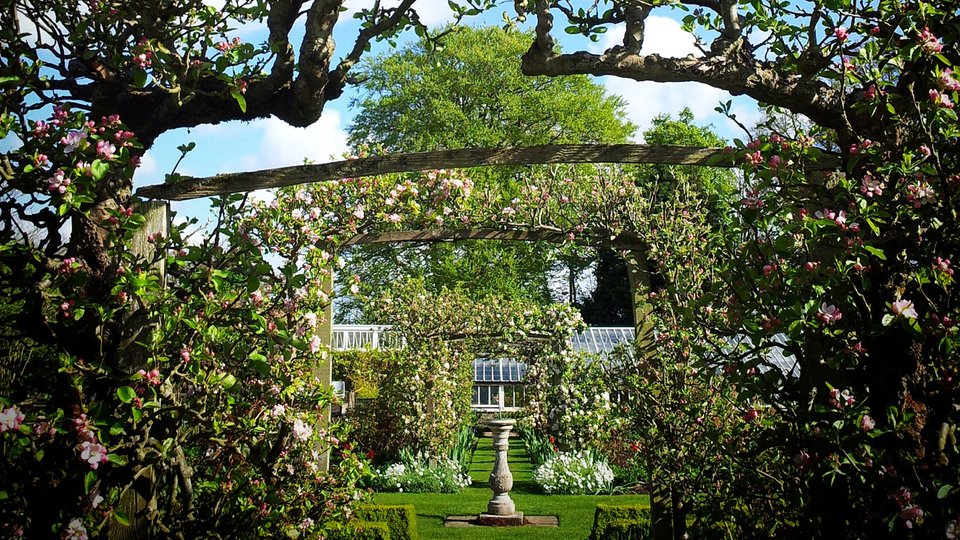
There is no prescribed ‘tour’ of Gunby’s gardens, but you may like to start through the white gate at the north east corner of the house. Arriving onto the lawn under the ancient cedar of Lebanon, you'll come to the the pergola garden, where you'll see a pair of lead urns filled with pelargoniums. These lead to a brick arch which takes you to the pergola beyond. This is in a series of simple supports over which apple trees are tightly pruned. Some of the many varieties are ‘James Grieve’ and ‘Kings Acre Pippin’ dating back to a list compiled in 1944.
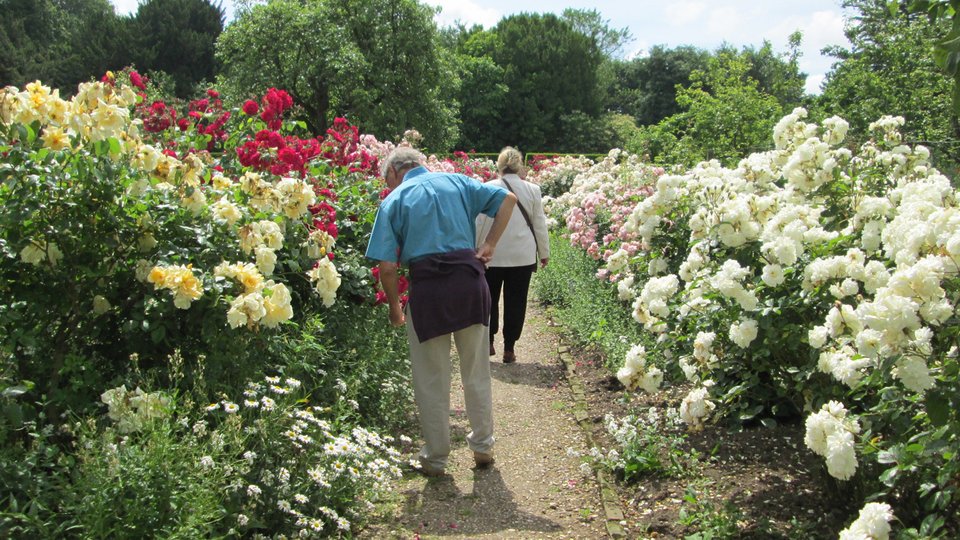
The walled compartment surrounding the pergolas, contains the cutting border, a rose garden, the yellow border and a herb garden. To the left the herbs (over 80 of them) have been re-arranged around a central stone trough. Both culinary and medicinal varieties would have been used in a country house of the scale of Gunby. The roses to the right include yellows and oranges Chinatown, Arthur Bell and Graham Stuart Thomas with reds Frensham, Wilhelm and Orange Triumph.
The little box edged lawn with its central sundial was probably laid out around 1900 by Margaret Massingberd, who also brought the little blue domed seat from elsewhere in the gardens as part of her re-planning of this area. Honeysuckle is planted on either side of the seat and frames the view of the mixed herbaceous border on the other side of the lawn.
Continue to the cutting borders that run down to the greenhouses either side of the pergola. Here the flowers are grown that are used for many of the flower arrangements in the house. The square brick building nearby is the dovecote. This is as old as the house (possibly older) and houses its resident flock of white doves, see if you can spot htem flying overhead. The gardening team can often be found near the Gunby greenhouse and potting shed, preparing and propagating plants for the season ahead. Gunby's garden cats are likely to be snoozing nearby, enjoying a catnap in the sun. See if you can spot Gunby's resident cats Craig and Committee. They love to welcome visitors to their gardens.
The Yellow Border is a double herbaceous border featuring unusual plants such as Buphthalmum speciosum, a large-headed yellow daisy, Achillea ‘Cloth of Gold’ and Ligularia clivorum ‘Desdemona’, another daisy, but orange this time with leaves tinted with purple. At the end, the arched gateway on the left leads past Kipling’s couplet, immortalised in stone, into the kitchen garden. " Our England is a garden, and such gardens are not made by singing, ‘O! How beautiful!' and sitting in the shade". - Rudyard Kipling, ‘The Glory of the Garden’.
It appears that of all the areas of the gardens at Gunby, the kitchen garden has altered least in appearance and usage over time. Paths divide the garden in four main compartments and the linking perimeter path are all recorded in Peregrine Massingberd’s plan of 1806. In the heyday of the gardens then and ever since the four compartments and wall beds have been in vegetable production. A list, dated 1806, recorded fruit trees on the garden walls, which included: White Magdalen peach, brown fig, Chaumontelle pear, Temple Nectrine, Nutmeg Peach and Breda Apricot.
Today pears, plums, gages and figs cover the walls with apples and more pears forming patterns down the central double herbaceous border. Flowers change from blues to oranges and red and back to blues and whites with the seasons. Roses, a gift to Lady Montgomery-Massingberd in 1962, form the centre path. These include the Pemberton hybrid musk roses ‘Penelope’, ‘Cornelia’ and ‘Prosperity’ famous for their heavy scent, at its best in the cool of a summer’s evening. Seasonal produce from the kitchen gardens is for sale in the tea-room.
Instead of a wall on the south side, a yew hedge divides the kitchen garden from the canal. Irish juniper trees are dotted along the formal line of the walk, which is known as the 'Ghost Walk'. A young woman of the Massingberd family died after the murder of her stable lad lover by her infuriated father. Her ghost is said to walk here. The dying boy’s curse is supposed to be responsible for the remarkably few occasions in the history of Gunby that the succession has passed directly from father to son. " It is this profuse combination of seasonable fruits and flowers…that invests Gunby with the air of a still living English country home" - James Lees-Milne, Gunby Guidebook, 1946.
Passing through the double iron gates, the path to the church runs straight on and two walks wind round to the right. One leads back up the south side of the canal whilst the other, left-hand one leads into a cherry walk, planted first in 1939. Only one of the original trees survives, a ‘Pyrus malus’. Re-planting has included a Great White, prunus serrulata ‘Tai haku’ which, in 1987, marked the sixtieth anniversary of The National Gardens Scheme, of which Gunby was an original supporter. The surprise view of the east front of the house leads you onto the east lawn.
The uninterrupted view of the east front of the house is framed by some fine specimen trees, a black mulberry, a robinia and a liquidambar aswell as a couple of cedars, all planted in the last couple of decades to provide succession to trees that have been lost during the twentieth century. In the shrubbery to the left Rosa cantabrigiensis makes a show, with ‘Wedding Day’ clambering through the holly behind.
Behind this shrubbery take the a wildflower walk snaking along the park boundary. In season it's bright with winter aconites, snowdrops, crocuses and primroses. The carpet of wood anemones is particularly beautiful in March and April. In 1904 a tennis lawn was created here due south of the house. On the East Lawn, a pair of box-edged beds holds hybrid tea roses ‘Mrs Oakley Fisher’ and the heavily scented ‘Etoile de Hollande’. The planting of the great cedar of Lebanon was in 1812. " …and enable me to make pleasant shady walks for the summer all around the mansion. Nothing can be more charming and delightful than the prospect of so many pretty rising plantations…" - Peregrine Massingberd, Journal entry 1812.
The current formal planting of a pair of parallel yew allees dates from 1902 with a stoned walk centrally leading to a sundial formed of a baluster from old Kew Bridge. Last year the Gunby front gardens were planted with onions to replicate a photo from the 1940s.
On the walls of the house ‘Sylvia’ and ‘Madame Butterfly’ fight for attention, whilst back in the courtyard the vigorous ‘Mermaid’ (a single yellow rose) climbs up by the little gate in the corner and ‘Breeze Hill’ climbs happily on the clock tower opposite in big cabbage roses of pinkish apricot.
* – Walks at Gunby Estate – *
* Gunby ice house pond walk *
A dog friendly walk, this is classified as 'Easy', takes about 30 minutes and covers one mile. On your way back from the ice house pond, look out for the remains of the former Gunby village, which was once a thriving settlement with 15 households in 1563, but had disappeared by the time the Hall was built in 1700.
Start at Gunby Hall.
* Monksthorpe Chapel walk *
A far more vigorous walk, this is classified as 'Moderate' and is dog-friendly. It is 6 to 8 miles long and will take at least two and a half hours. If you want to explore the inside of Monksthorpe Chapel, the key is available daily between February and October from Gunby Hall & Gardens for a fully refundable £20 cash deposit. In addition to those at Gunby Hall, there are toilets at Monksthorpe Chapel
Start: Gunby Hall and Gardens
* Gunby Hall to Bratoft Manor walk *
Cross the former East Lincolnshire Line and discover the Medieval moated manor site, the former home of the Massingberds of Gunby. This walk is classified as 'Easy', covers about four miles and will take a little over an hour and a half. It is dog friendly.
Start: Gunby Hall and Gardens.
* – Visiting – *
‘I could live here!’, is what most people say when visiting Gunby Hall and Gardens. Modest-sized rooms full of character and charm make it easy to imagine you can move in yourself. With links to Tennyson, Darwin and Vaughan-Williams there is so much to discover about the family home of the Massingberd family.
Explore three floors of the hall full of interesting collection pieces amassed over generations from 1700 until 1967. Chat to their room guides to find out stories about Gunby’s interesting past. Stroll through our eight-acre gardens and enjoy the different areas: sweeping formal lawns, flower borders, vegetable gardens and wildflower corners. Complete your visit with a stop in the charming tea-room and enjoy some cake and a nice cuppa.
General Access.
Family
Accessibility.
Location : Gunby, Spilsby, Lincolnshire, PE23 5SS
Transport: Skegness (National Rail) then bus (7.5 miles). Bus routes: No.6 from Lincoln and Skegness. Layby at Gunby roundabout is a request stop. 530 yards walk to entrance.
Opening Times : Daily, 11:00 to 17:00, April to October.
Tickets : Adults £8.10; Children £4.05 ; Family £19.50.
Tickets Group (minimum 15 people): Adults £6.50; Children £3.50.
Tel: 0175 4890102

