Dunwich Heath is an area of coastal lowland heath just south of the village of Dunwich, in the Suffolk Coast and Heaths AONB. It is adjacent to the RSPB reserve at Minsmere. It lies within the area of the Minsmere-Walberswick Heaths and Marshes Site of Special Scientific Interest, Special Area of Conservation and Special Protection Area. It has been owned by the National Trust since 1968, when it was bought with the help of a donation from the Heinz company as part of Enterprise Neptune.
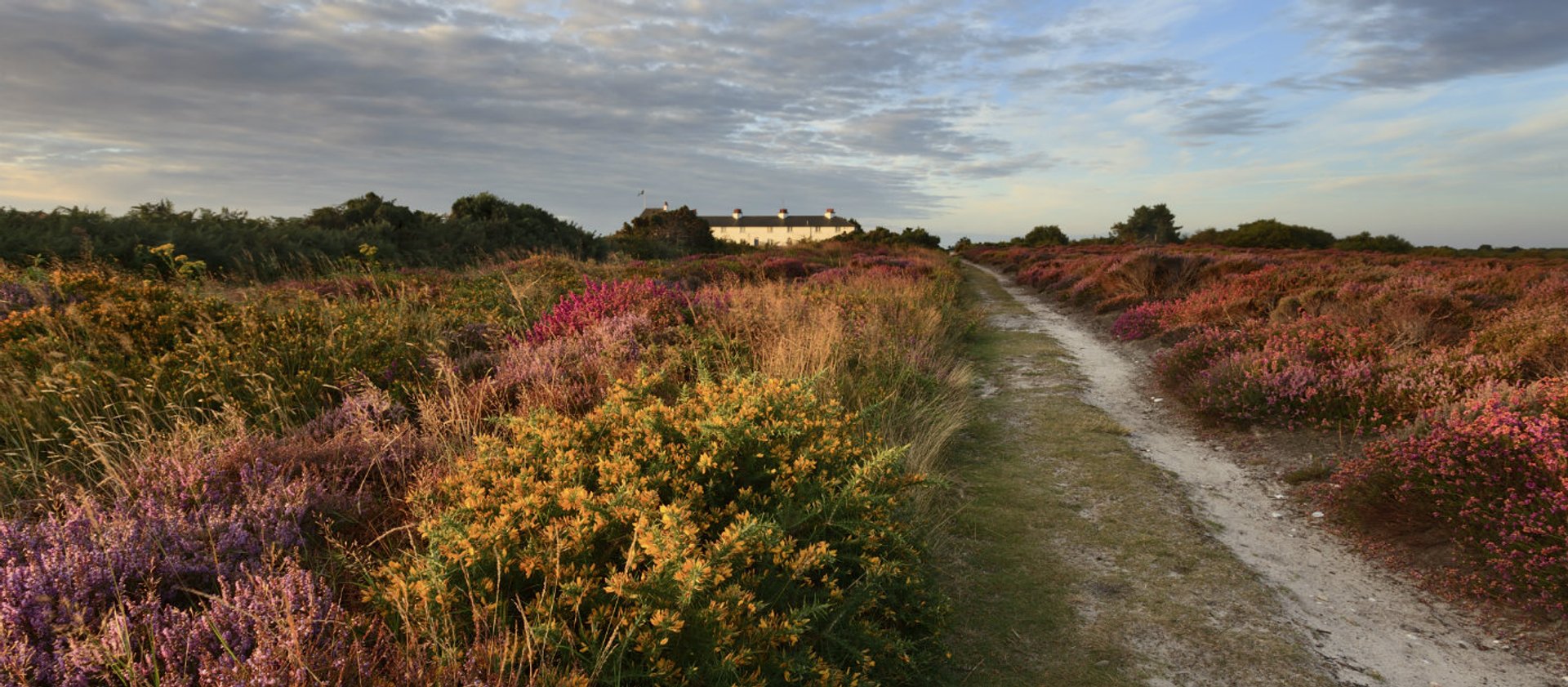
Dunwich Heath is a rare survival of coastal lowland heath; the Suffolk Sandlings used to form a lot of the Suffolk coast, but have mostly been developed for agriculture or built upon. The heath is mostly covered with heather, both Common Heather and Bell Heather, and European and Western Gorse but there is also some woodland and grassland included in the reserve. The heather and gorse flower from June until September; the heather is purple and pink while the gorse is yellow.
A variety of birds, animals and reptiles live on the heath; red deer, muntjacs, Dartford warblers, stonechats, and nightjars, as well as adders, slowworms, grass snakes and common lizards. It supports many unusual invertebrates as well, such as ant lions, digger wasps, mining bees, as well as the true lover's knot moth, and the emperor moth.
History
The National Trust are celebrating a special anniversary at Dunwich Heath this year - it’s 50 years since this beautiful site came into their care. Nestled on the Suffolk coast, Dunwich Heath is a surviving fragment of precious lowland heath – one of the UK’s rarest habitats. Its sweeping slopes of heather and gorse, sandy soil and acid grassland support many insects, birds and animals which depend on this specialised heathland habitat. But 50 years ago, Dunwich Heath’s future seemed uncertain.
During the Second World War, Dunwich Heath was requisitioned by the military as a training area. After the war it was handed back to its owners, the Dunwich Town Trust, and became an increasingly popular destination for tourists. By 1968, there were concerns that unregulated camping was damaging the fragile landscape. In addition, the Caravan Sites and Control of Development Act 1960, meant that if the Dunwich Town Trust wanted to continue allowing camping at the site, they would need to provide facilities, toilets and water points for visitors. Unwilling to develop Dunwich Heath as a campsite, they decided that the National Trust would be the best organisation to secure the future of this special landscape.
The site became the first property in Suffolk to be purchased through the National Trust Enterprise Neptune Campaign. This important acquisition of around 250 acres and a mile of shingle beach was made possible by a substantial bequest from H.J Heinz Co. Ltd. Their donation was worth £12,000 in 1968. On 27th March 1968, a ceremony took place on the heath formally transferring the site into the care of The National Trust ensuring its preservation for future generations. The Duke of Grafton, Chairman of the East Anglia Regional Committee of The National Trust, unveiled a new National Trust sign with Mr Anthony Beresford, Managing Director of H. J. Heinz Ltd, and Mr Jack Docwra, the first warden of the new nature reserve.
Dunwich Heath was once part of a large area of lowland heath, known as the Sandlings. This rare habitat has declined nationally at a rate of 92% in the last 120 years threatening heathland wildlife and plant species. In the early 1970’s, Dunwich Heath became part of Suffolk Coasts and Heaths Area of Outstanding Natural Beauty (AONB), and a Site of Special Scientific Interest (SSSI).
Dunwich Heath was further extended when 79 acres from Mount Pleasant Farm, north of the main site, was purchased with a donation from Pizza Express in 2002! Their seafood ‘Neptune’ pizza was sold to raise money for the Enterprise Neptune Campaign. The former arable land is being restored to acid grassland and heather heath replacing lost habitat and providing new areas for rare breeding birds such as stone curlew and woodlark. In 2015, a community grant awarded by the WREN Land Acquisition Fund and a further grant from the Enterprise Neptune Campaign enabled The National Trust to purchase a privately owned area of heathland which sat between the main heath and Mount Pleasant Farm. The continued conservation work by staff and volunteers at Dunwich Heath has been richly rewarded with the success of some key species. After an absence of nearly 60 years, Dunwich Heath became the first site in East Anglia to record breeding Dartford warblers. Around 35 pairs of these elusive little birds are now resident at Dunwich Heath all year round. Another major success has been the first successful breeding of stone curlews in 2017. Following failed attempts to breed in previous years, we were delighted to watch their first chick grow and successfully fledge. Dunwich Heath supports many other heathland species; birds such as woodlark and nightjar, and rare insects including antlion, silver-studded blue butterfly and green tiger beetle make their homes here.
With its gentle slopes of heather reaching to the sea, Dunwich Heath has an enduring charm. In the care of the National Trust, it will continue to provide both an important space for wildlife to thrive and a special place for everybody to enjoy for years to come.
** – The 'Woof' Guide – **
Dunwich Heath is an important nature reserve and is very popular with dogs and their families. The information below will help you understand how to make the most of your visits with the National Trust at the Heath. Dogs are welcome throughout Dunwich Heath and they even let you bring them inside their tea room for a rest and a cool drink of water.
** – Visiting – **
A warm welcome awaits you in the Coastguard Cottages tea room, relax and enjoy a cuppa outdoors in their seating area, or head upstairs to the lookout and enjoy stunning panoramic views over the sea. Their small, friendly team prepares freshly made food using ethically sourced ingredients. Enjoy a light lunch of homemade soup, fresh sandwiches or savoury one-pot, or drop in for afternoon tea with freshly baked scones and delicious cakes. Dunwich Heath's scones are legendary! So, don't forget to pick up a Scone Club loyalty card to collect points and claim your free scone. Your four-legged friends needn't miss out - well behaved dogs are welcome in the tea room.
Whether you're planning a long walk on the beach or you're just back from an early bird stroll on the heath, why not treat yourself to a hearty brunch available on the second weekend of each month? You can enjoy a tasty brunch of 2 bacon rashers, 2 sausages, 2 fried eggs, tomato, baked beans, 2 rounds of toast and a tea or filter coffee for £9.95. This set brunch is available on selected dates only, so please check before you come along!
Find out what's coming up at Dunwich Heath this spring! Discover walks through beautiful heathland, fun activities to get your little ones enjoying the great outdoors, and events to connect you with nature and the wildlife of Dunwich Heath. Coming up at Dunwich Heath.
** – Facilities – **
General
Family
Accessibility
Location : Coastguard Cottages, Minsmere Road, Dunwich, Suffolk, IP17 3DJ
Transport: Darsham (National Rail) 6 miles. Bus routes: demand-responsive bus from Darsham train station and Saxmundham (booking essential, 01728 833526)
Opening Times : Heath, from dawn till dusk.
Opening Times : Cafe and Visitor Centre 10:00 to 17.00.
Tickets : Free; car parking see above.
Tel: 01728 648501

